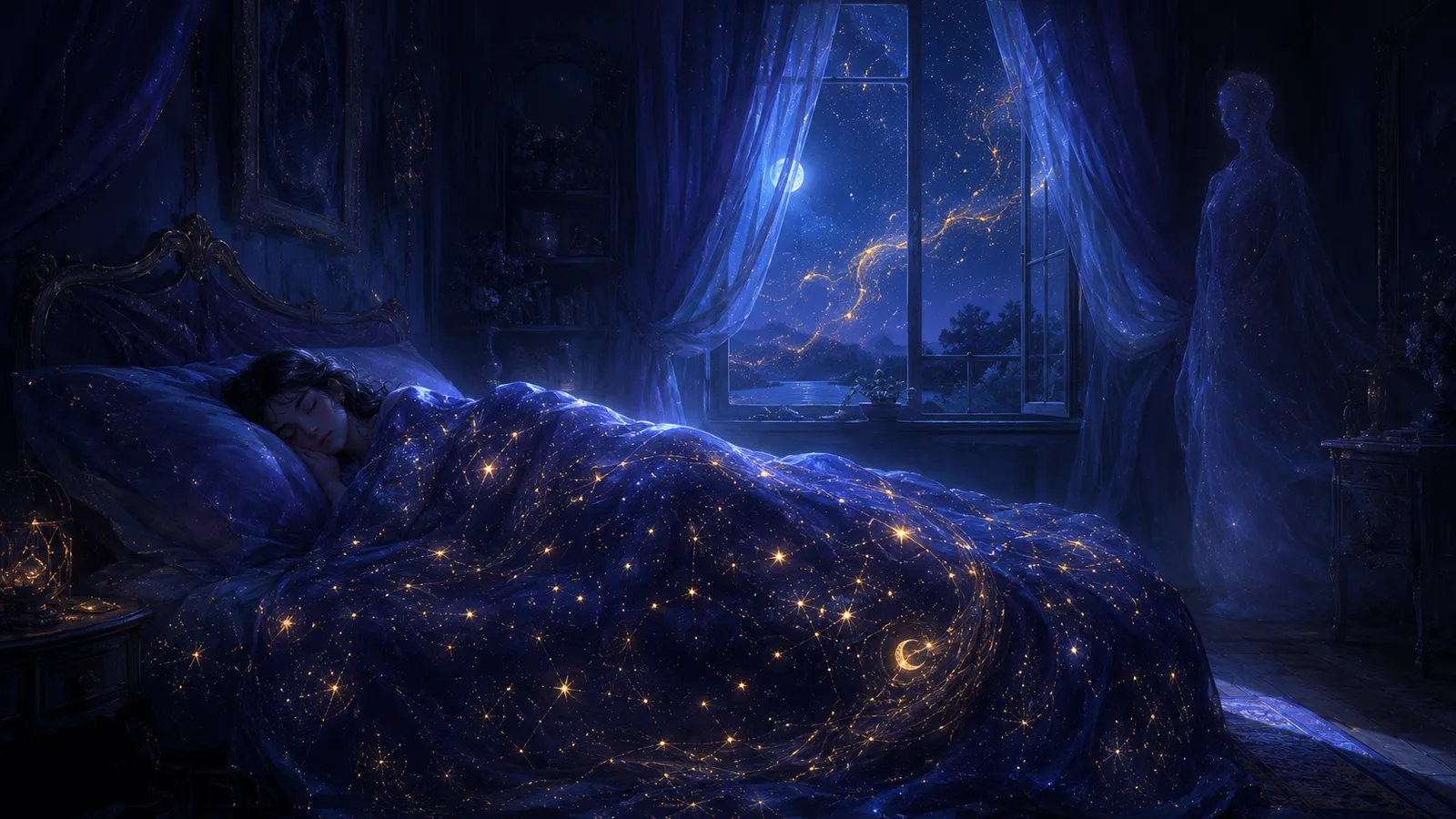
You wake, or you think you wake. Your eyes are open, the room is your room, but you cannot move a muscle. There is a weight pressing on your chest, and worse, the certainty that something is in the room with you, standing in the corner or leaning over the bed. You try to scream and nothing comes. Then, after seconds that feel like forever, it lets go, and you can move again.
It is one of the most terrifying experiences a sleeping body can produce, and one of the most misunderstood. If it has happened to you, the most important thing to know first is this: you were never in danger, and the figure you saw was not really there. Here is what was.
What sleep paralysis actually is
Sleep paralysis is a brief overlap between two states that are not meant to meet: dreaming and waking. During the dreaming stage of sleep, your body is naturally paralysed, a built-in safeguard called REM atonia that stops you from physically acting out your dreams. Normally this paralysis switches off the instant before you wake. In sleep paralysis, your mind wakes up while your body is still held in that switched-off state.
So you are conscious, aware of your real surroundings, but unable to move or speak, because the part of your brain that should have released your muscles has not caught up yet. It usually lasts only a few seconds to a couple of minutes, and it always ends on its own. As frightening as it is, it is medically harmless. It is extraordinarily common, with a large share of people experiencing it at least once in their lives.
Knowing this does not make it pleasant. But it does change the story you tell yourself in the moment, from something is attacking me to my body just woke up a few seconds out of order. That shift, practised ahead of time, is one of the most useful things you can carry into the next episode.
Why it happens
Sleep paralysis is far more likely when your sleep is disrupted, which is why it often arrives during stressful, exhausting, or chaotic periods of life. The most common triggers are well known and, helpfully, mostly within your control.
Sleep deprivation and an irregular sleep schedule are the biggest culprits, which is why it spikes during exam seasons, new-parent months, jet lag, and shift work. High stress and anxiety make it more likely, as does sleeping on your back, which seems to increase the odds of an episode for many people. It can also run in families, and in some cases it is associated with conditions like narcolepsy, which is worth mentioning to a doctor if episodes are frequent.
In other words, sleep paralysis is usually your body telling you that your rest has been too thin or too broken lately. It is unsettling, but it is also information, and the same things that ease it are simply the things that make for steadier sleep overall.
The figure in the room
The strangest and most frightening part of sleep paralysis is not the stillness. It is the presence. Many people sense, or vividly see, an intruder, a shadow figure, a hag, a demon, or some dark shape in the room, often accompanied by crushing pressure on the chest as though something is sitting on them. These are hallucinations, occurring in the blurred zone between dreaming and waking, where dream imagery spills into your perception of the real room.
What is genuinely remarkable is how consistent these visions are across the world. Cultures that had no contact with one another all developed names and folklore for the same experience: the Old Hag who sits on the sleeper's chest, the night demon, the witch, the shadow man. People who have never heard of any of this still report the identical shadowy figure and the same crushing weight. That tells you the figure is not personal and not supernatural. It is a deep, shared feature of how the human brain misfires in this particular state.
The chest pressure has a physical basis too. In REM sleep your breathing is shallow and partly automatic, so when you wake into paralysis and try to breathe deliberately against it, it can feel like a weight holding you down. Your fear-driven brain then supplies a culprit for the weight, and the shadow in the corner is born.
Why it feels so terrifying
Sleep paralysis hijacks the exact machinery that evolved to keep you alive. You are immobile, you cannot call out, and a primal part of your brain, the threat-detection system, is fully switched on while the rational part is still half asleep. Your body is flooded with alarm and given nothing it can do about it. That combination, helplessness plus high alert, is close to the recipe for pure terror.
This is why the experience can feel so much more intense than an ordinary nightmare. In a nightmare you are at least moving through a dream. In sleep paralysis you are awake, in your real bed, and genuinely cannot move, which makes the threatening presence feel utterly real. Understanding that the terror is your alarm system firing without an actual threat is the first step to taking some of its power away.
How to get through an episode
In the moment, the instinct is to fight, to strain against the paralysis with everything you have. This usually makes it worse and more frightening. The calmer path is to remember that it will end, because it always does, often within a minute, whether you struggle or not.
A few things help. Rather than trying to move your whole body, focus on wiggling one small thing, a finger, a toe, your tongue. That small, achievable movement is often what tips your body back into full waking control. Slow your breathing as much as you can and let it be shallow if it must be; you are getting enough air even when it does not feel like it. And if you can, remind yourself, even wordlessly, that the figure is a hallucination and the paralysis is temporary. People who learn to meet it with that knowledge often find the fear fades faster each time.
How to reduce it, and when to see a doctor
Because sleep paralysis is so closely tied to disrupted sleep, the best prevention is steadier rest. Aim for a regular sleep schedule, including on weekends, and protect enough hours for real sleep. Wind down before bed, ease off screens and stimulation, and manage stress where you can, since anxiety is one of the strongest triggers. If you tend to have episodes on your back, trying to sleep on your side may genuinely reduce them.
Most people never need more than that. But if episodes are frequent, deeply distressing, or paired with daytime sleepiness or sudden loss of muscle control, it is worth talking to a doctor, who can rule out conditions like narcolepsy and help you sleep more safely. There is no shame in it, and there is real help available.
If you want to make sense of the imagery itself, you can look up the demon or other figures in the encyclopedia, or write the episode down and decode it gently, line by line. The shadow that visited you is one of the oldest images humans have, and it has frightened sleepers for as long as there have been sleepers. Knowing what it is does not just calm the next episode. It quietly returns the night to you.