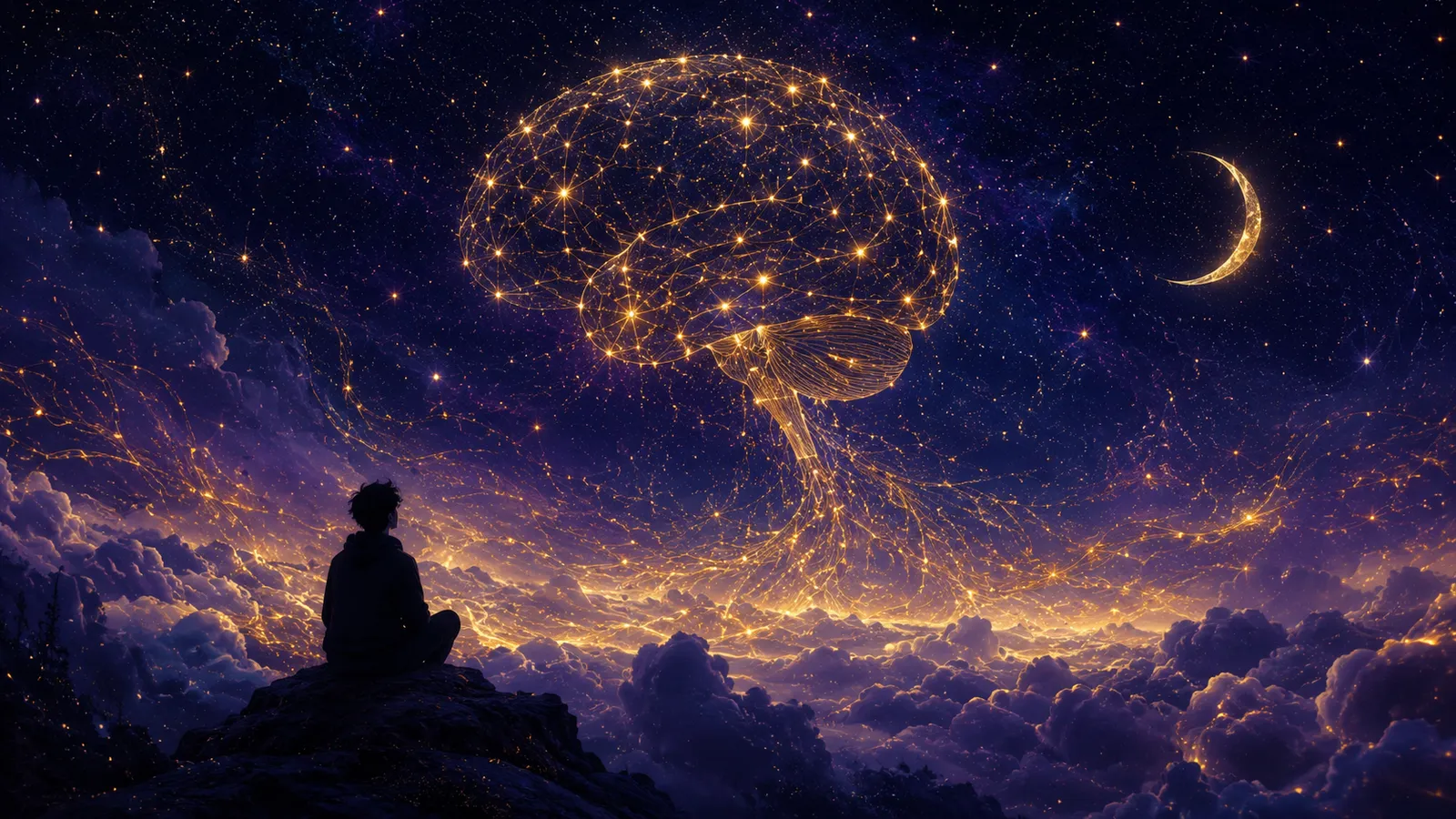
For thousands of years, people who woke from a strange dream had two options: shrug it off, or carry it to someone wiser, a priest, an elder, an analyst, a dog-eared symbol dictionary. In 2026, there is a third option that did not exist a few years ago. You can type the dream into an AI and have a thoughtful interpretation looking back at you in seconds.
It sounds either miraculous or suspicious, depending on your mood. The honest answer is somewhere in between, and far more interesting than either. Here is what AI can really do with a dream, what it genuinely cannot, and how to get a reading that actually helps.
An ancient question meets a new tool
The wish to understand our dreams is one of the oldest human impulses. Every culture has had its dream interpreters, and the modern era added Freud, Jung, and decades of sleep science. What is new is not the question, but the speed and the access. For the first time, anyone, at three in the morning, can describe a dream in their own words and receive an interpretation drawing on more frameworks than any single human interpreter could hold in their head.
That accessibility is the real shift. Most people never had a Jungian analyst or a wise grandmother to ask. They had a vague memory, a flicker of unease, and no one to talk to. AI does not replace deep human insight, but it does put a thoughtful first conversation about a dream within reach of almost everyone, which is genuinely new.
How AI actually interprets a dream
It helps to demystify what is happening. AI does not peer into your soul, and it is not reading a fixed cosmic dictionary where snake always equals one thing. What a good dream-interpretation AI does is recognise patterns. It has learned from an enormous range of human writing about dreams, psychology, symbolism, and emotion, and it uses that to connect the images in your dream to the meanings people have long associated with them.
The better tools read a single dream through several lenses at once: the Jungian view of symbols and archetypes, Freudian ideas about hidden wishes, cognitive science on memory and emotion, and the cultural and spiritual traditions that give symbols their weight. A human interpreter usually works from one school. AI can hold several and show you where they agree and disagree, which often reveals more than any single reading.
The real advantage shows up over time. Because an AI can remember and compare your dreams, it can notice patterns a one-off interpretation never could: the symbol that keeps returning, the feeling that recurs before stressful weeks, the way a certain figure shows up whenever a particular part of your life is unsettled. Recurring-pattern tracking is something the old symbol dictionaries simply could not do.
What the science says about dreams and machines
Alongside interpretation, there is a separate and genuinely startling line of research: using technology to read and even influence dreams from the outside. Researchers have shown that machine-learning models can detect, from brain activity alone, whether someone is dreaming, and recent international efforts have built large public databases pairing brain recordings with dream reports to push this further.
Even more striking is the work on shaping dreams. Studies on targeted dream incubation have shown that gentle cues delivered as a person drifts into sleep can reliably steer what they dream about, and that dreaming about a problem can measurably improve how people solve it afterward. This is real, peer-reviewed science, not science fiction, and it is changing how seriously the field treats dreams as something we can study and even guide.
It is worth being clear about the limits, though. No technology can currently watch your dream like a film or read its meaning off your brain. Detecting that you are dreaming is a long way from knowing what the dream means to you. The science is remarkable and still early, and honest interpretation, by a human or an AI, still depends on what you can describe and feel, not on a brain scan.
What AI does well, and what it cannot do
AI is genuinely good at several things here. It is available the moment you wake, when the dream is freshest. It carries more symbolic and psychological frameworks than any one person, and it offers them without judgement, which matters for dreams people feel embarrassed to say aloud. It is patient, it can track patterns across months, and it never gets tired of your questions.
But there are real limits, and a good tool is honest about them. AI does not know your life: the argument you had yesterday, the grief you are carrying, the private meaning a particular house or person holds only for you. It can offer possibilities, but you are the only one who can confirm which one rings true. It cannot replace a therapist for dreams tangled up with trauma or serious distress. And it should never hand you certainty, because dreams do not deal in certainty. Anything that tells you exactly what your dream means is overpromising.
The most useful way to think of it is as a thoughtful conversation partner, not an oracle. It brings the frameworks and the patterns. You bring the life the dream is actually about. The meaning lives in the meeting of the two.
How to get an interpretation worth keeping
The quality of an AI dream interpretation depends enormously on what you give it. A few small habits make the difference between a generic answer and one that genuinely lands.
Write the dream down the moment you wake, before it fades, and include as much detail as you can: not just what happened, but how it felt, which moments were vivid, where the fear or joy peaked. Feelings are the most important data in a dream, and the most often left out. Then add a little context about your waking life, what is happening, what is weighing on you, since the same dream means different things in different seasons. And stay honest. The interpretation is only as truthful as the dream you are willing to describe.
Finally, treat the result as a starting point, not a verdict. Read it, notice what resonates and what does not, and let the parts that ring true open a conversation with yourself. The goal is not to be told what your dream means. It is to understand yourself a little better than you did before you asked.
The honest bottom line
So, can AI interpret your dreams? Yes, in the way that matters most: it can offer thoughtful, multi-framework, judgement-free interpretations, track your patterns over time, and give almost anyone a meaningful first conversation about a dream that they would never otherwise have had. What it cannot do is know your life for you or hand you certainty, and any tool that claims otherwise is not being honest with you.
Used well, that is more than enough to be genuinely valuable. A good AI interpretation will not tell you what to think. It will hand you back your own dream, a little clearer, with a few doors opened that you can choose to walk through. If you have a dream still turning over in your mind, you can decode it now in your own words and see what it has been trying to say.