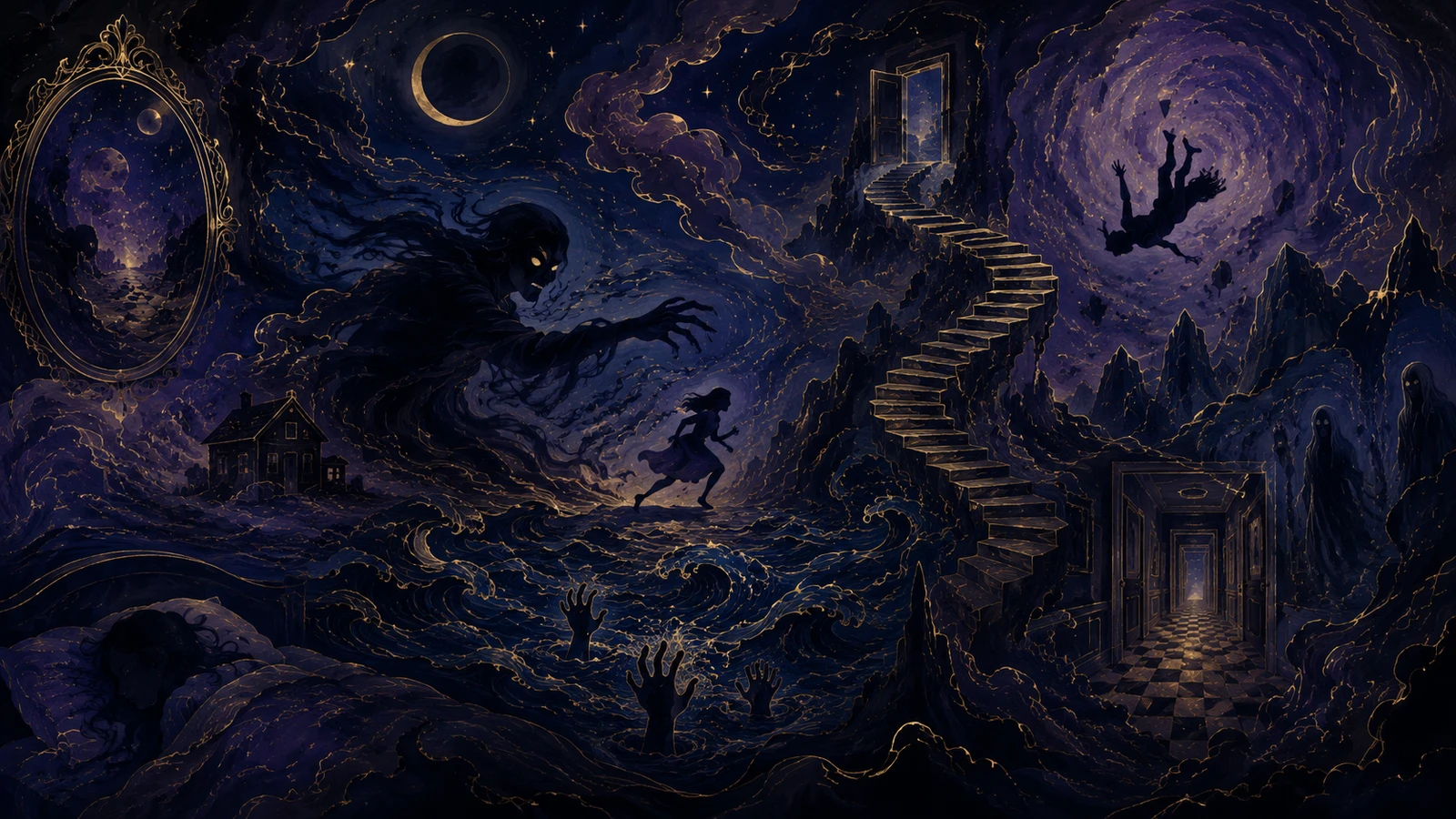
Nightmares feel personal, but the most frightening ones are remarkably shared. The same handful of scenes return across countries, generations, and bedrooms: the chase you can't outrun, the teeth in your hand, the door you can't lock in time. Behind the horror, the imagery is almost always doing useful work.
This is a quiet field guide to fifteen of them. Each entry takes a familiar nightmare and turns it slightly, from threat to message. Read slowly. The point is not to be brave about your bad dreams. The point is to understand what they've been trying to say while you were too scared to listen.
Why nightmares feel different from regular dreams
A nightmare is a dream that wakes you because the feeling has gotten too loud to stay asleep through. The body believes the danger is real, the heart climbs, the room feels small. That intensity is not a sign that something terrible is coming. It is a sign that something honest is asking to be felt.
Most nightmares are not about the future. They are about something already inside you, something you've been carrying without quite naming. The image is the disguise. Underneath it is almost always a quieter, older feeling, waiting patiently to be acknowledged.
The 15 most common nightmares
Being chased by something faceless
A faceless pursuer in a dream is rarely a person. It is a feeling you have been outrunning while awake. Grief you haven't allowed, an ambition you've been pretending not to have, a truth about yourself you keep one corner ahead of. The face is missing because you have not yet looked. The dream is asking you, very gently, to stop and turn around.
Falling and never landing
A fall that never reaches the ground belongs to a particular kind of fear: the fear of losing footing without knowing where the bottom is. It often arrives during transitions where the next solid thing has not yet appeared. The endlessness is the message. Your psyche is showing you that the uncertainty itself is what you're really afraid of, not the impact.
Teeth crumbling out of your mouth
Teeth are the part of you that bites, speaks, smiles, and holds on. When they crumble, something about your voice or your sense of competence is feeling fragile. These dreams come during exposure: a new role, a public moment, a quiet shame nobody else knows about. The horror is doing useful work. It points to where confidence has thinned without your permission.
Showing up naked or unprepared
The classroom you forgot about, the stage you didn't rehearse for, the body without clothes. These dreams are about exposure, not about literal nudity or failure. A part of you feels seen without the costume you usually wear. Notice the people around you in the dream. Their reaction is almost always your own quiet verdict on yourself, smuggled in from waking life.
Being attacked but unable to fight back
A dream where your arms feel heavy, your voice won't come, your fists land softly on someone who keeps coming, is rarely about violence. It is about a place in your waking life where you feel you cannot push back. A boundary you didn't set, a no that didn't make it out, a power you forgot was yours. The body knows it before you do.
Drowning or being pulled underwater
Water in dreams is almost always emotional life. Drowning arrives when feeling has outgrown the container. Grief, responsibility, a relationship asking more than you have left. Going under is the moment your psyche stops pretending the load is manageable. It is less a warning and more a quiet request to let someone witness what you've been holding alone.
Trapped in a building you can't escape
Endless corridors, doors that lead back to where you started, a building that rearranges itself behind you. These dreams come when something in your waking life feels inescapable: a job, a role, a story you keep telling about yourself. The architecture is the trap, but it is also a map. The dream is showing you the shape of what you haven't yet decided to leave.
Someone you love dying
Dreams of losing someone you love are some of the most painful to wake from, and almost never literal. They tend to surface when something in the relationship is changing: distance, growth, a quiet shift you have not put into words. The dream borrows the most extreme image of loss to mark a smaller, real one. The grief in it is real. The death in it usually is not.
House break-in: a stranger inside your home
A house in a dream is almost always you. A stranger inside it is something that should not be where it is: a thought, an influence, a person who has gotten further into your inner life than you meant to allow. These dreams come at the edge of recognising that something has crossed a line. The locks in the dream are usually fine. The locks in your waking life are what the dream is asking about.
Being lost somewhere you should know
The street you grew up on, the school you went to, a city you've lived in for years, suddenly unfamiliar. Lost dreams in known places arrive when your inner compass is recalibrating faster than your outer life. Something about who you are is shifting, and the old map is no longer accurate. The disorientation is honest. It usually means you're closer to a real change than you've admitted.
Paralysis: awake but unable to move
Sleep paralysis dreams have a specific physical cause and a real emotional weight. The body holds itself still during REM, the mind comes online too early, and for a moment you are awake inside a body you cannot move. The terror is genuine. So is the message underneath: somewhere in your waking life you have been feeling unable to act on something that matters. The dream is naming the stuckness, not creating it.
Watching your body do something you can't stop
You hurt someone, you say the unsayable thing, you walk off an edge, and you watch yourself do it from somewhere just behind your own eyes. These dreams come when a part of you has been disowned: an anger, a desire, a truth that doesn't match the version of yourself you show the world. The horror is not that you would do it. The horror is that you have been carrying it alone.
Realising you've forgotten a child or pet
You suddenly remember a baby in another room, a dog you haven't fed in days, a child you left somewhere and didn't think about. These dreams almost never mean you are a bad caretaker. They mean something tender and dependent in your own life has been neglected: a project, a friendship, a part of yourself that needs you. The dream uses the most painful image it has to get your attention.
Endless exam you can't pass
The exam you can't finish, the questions you can't read, the room that won't let you leave until you're done. These dreams arrive when you feel measured and found short, often by a standard you didn't consciously agree to. Work, family, your own quiet perfectionism. The harshest examiner is almost always inside. Noticing that is usually the first honest step out of the room.
Being late for something irreversible
A train you can't catch, a wedding already underway, a goodbye you didn't reach in time. Lateness in nightmares is rarely about the clock. It is about a quiet grief over timing: a chance you fear you missed, a version of your life you fear you won't reach. The dream is not punishing you. It is asking whether the schedule you're measuring yourself against is even your own.
What to do when a nightmare keeps returning
A returning nightmare is usually a returning feeling. The image stays the same because the feeling has not yet been allowed in waking life. Try to meet the dream gently. Write it down in the morning, in plain language. Notice the feeling first, the symbol second. Ask what part of your life right now wears the same shape as that fear.
If the same nightmare wakes you for weeks, please be kind to yourself about it. Talk to someone you trust. Imagery rehearsal therapy and trauma-focused therapy can soften repeating nightmares within a few sessions, and there is no medal for carrying a bad dream alone. You are allowed to ask for help. You are allowed to sleep softly inside your own bed.